Engineered Bush Hammered Granite Varieties for Immediate Export
Precision-calibrated natural stone modules manufactured to ASTM C615 and European EN 1341 standards for commercial plazas, pedestrian concourses, and external cladding.
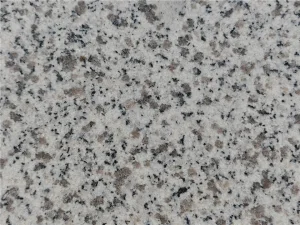
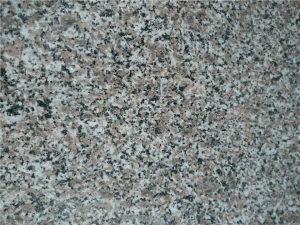
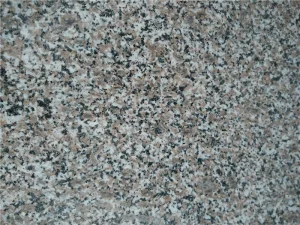
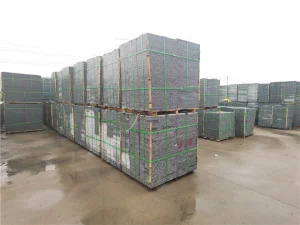
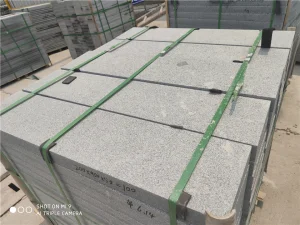
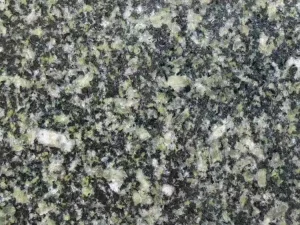
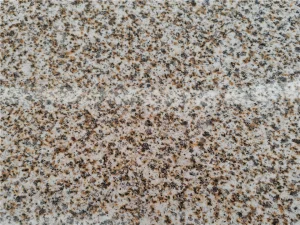
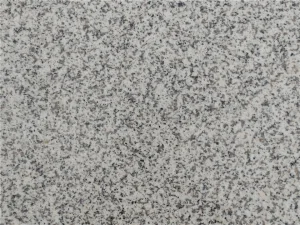
Bush Hammered (Lychee Surface) Granite: The Micro-Percussive Advantage
Analyzing the metallurgical impact, surface morphology, and mechanical integrity differentiation between automated carbide-head percussion and thermal thermal-shock spalling.
Mechanical Principles of the Lychee (Bush Hammered) Texture
The bush-hammered finish—colloquially designated across Asian manufacturing centers as the Lychee (Litchi) Surface (荔枝面)—is a specialized non-slip texture produced through repetitive, high-frequency mechanical percussion. Unlike sawn, polished, or honed surfaces that preserve the planar integrity of the quartz and feldspar grain boundaries, the bush-hammered method utilizes pneumatic or electro-mechanical tooling equipped with multi-point pyramidal tungsten carbide teeth.
These percussive heads strike the calibrated sawn slab with standardized kinetic force, micro-fracturing the uppermost crystal matrix to a depth of 0.8 mm to 2.5 mm. This creates a uniformly cratered, high-relief micro-topography resembling the peel of a lychee fruit. The resulting surface scatters incident light to produce a softened, pastel-like tonal register while significantly augmenting macroscopic mechanical interlock for pedestrian foot traffic and vehicular tires.
Thermal Stress vs. Cold Mechanical Impact: Flamed finishes expose stone to 1,800°C–2,500°C oxy-propane jet flames, inducing extreme thermal gradients that spall quartz crystals. This process inevitably induces micro-lattice fissures up to 3 mm into the stone core, decreasing flexural strength by 12% to 22%. Conversely, automated cold bush-hammering preserves the substrate's structural modulus while achieving superior, non-directional coefficient of friction.
Petrographic Behavior Under Percussion
Natural intrusive igneous rocks—specifically the granodiorites, biotite granites, and quartz monzonites quarried in Shandong (such as G603 Sesame White, G602, and G3760 Shandong White)—exhibit distinctive mineralogical responses during automated bush hammering:
1. Quartz (SiO₂): Possesses a Mohs hardness of 7 with no cleavage planes. Under percussive carbide impact, quartz undergoes conchoidal micro-chipping, forming ultra-durable angular micro-facets that provide permanent slip resistance resistant to mechanical polish wear.
2. Potassium & Plagioclase Feldspars: Featuring distinct orthogonal cleavage, feldspars micro-shatter along structural planes. This selectively lightens the perceived color of dark minerals, creating an architecturally desirable muted hue that conceals ambient dirt and dust.
3. Biotite & Amphiboles: Soft sheet silicates (Mohs 2.5–3) are slightly excavated by the tooling, yielding microscopic depressions that accelerate water dispersal under foot, drastically eliminating aquaplaning risks on external walkways.
Pendulum Test Value (PTV) > 65
Exceeds international pedestrian safety thresholds. Tested under BS 7976-2 and ASTM C1028, bush-hammered granite provides ultra-safe slip resistance in both wet and dry environmental exposures, eliminating liability in public squares and subway stations.
Sub-Millimeter CNC Calibration
Precision multi-blade diamond gang sawing followed by dual-axis planetary bush-hammering lines guarantees thickness tolerances within ±1.0 mm, enabling direct adhesive thin-bed or pedestal installations without costly manual site-leveling.
Freeze-Thaw Durability
Because mechanical carbide impact eliminates thermal spall fracturing, bush-hammered granite demonstrates zero spalling, pitting, or micro-delamination after 56 freeze-thaw cycles under European Standard EN 12371 testing protocols.
B2B Specifications, Urban Solutions, & Commercial Hardscaping
How international municipal authorities, Tier-1 contractors, and landscape architects solve modern pedestrian safety, facade glare, and durability challenges with bush-hammered granite.
Transit Hubs & Airports
High-density passenger concourses demand zero slip risks, high scratch abrasion resistance (EN 14157 class A1), and resistance to luggage wheel friction without surface gloss erosion or polish decay.
Universal Access Paving
Precision tactile indicator units (blister, directional, and hazardous warning pavers) require distinct relief profiles. Our CNC bush-hammered tooling textures the base surface while keeping raised studs sharply defined.
Zero-Glare Rainscreens
Urban facade zoning codes increasingly mandate non-reflective exterior envelopes to prevent driver glare and heat-island concentration. Bush-hammered granite diffuses 98% of direct solar incidence across the building skin.
Civic Water Features
Interactive fountains, splash pads, and swimming pool copings require continuous submersed slip protection. Lychee texture maintains wet PTV > 55 even when coated with a continuous biological biofilm or chlorinated film.
Petrophysical Testing & Specification Benchmarks
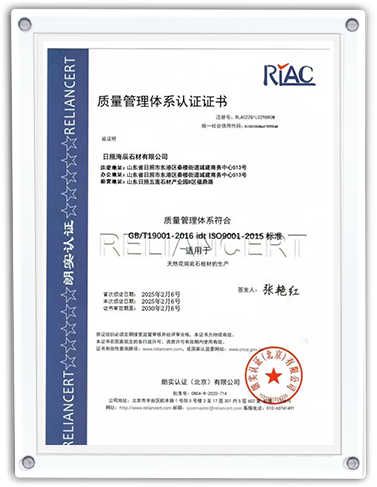
Batch-tested laboratory data conforming to ASTM C615 / C170 / C880 and European EN 1341 requirements. Verified at Haichen Stone's in-house laboratory prior to export release.
| Granite Designation | Geological Type | Bulk Density (kg/m³) | Water Absorption (%) | Compressive Strength (MPa) | Slip Resistance (Wet PTV) | Standard Applications |
|---|---|---|---|---|---|---|
| G603 Sesame White | Biotite Granite | 2,650 (ASTM C97) | 0.28% (ASTM C97) | 168 MPa (ASTM C170) | PTV 68 (Low Risk) | Municipal Plazas, Metro Kerbs, Heavy Paving |
| G602 Sesame White | Fine-Grain Monzonite | 2,620 (ASTM C97) | 0.32% (ASTM C97) | 152 MPa (ASTM C170) | PTV 66 (Low Risk) | Commercial Terraces, Sidewalks, Steps |
| G3760 Shandong White | Leucocratic Granite | 2,630 (ASTM C97) | 0.24% (ASTM C97) | 160 MPa (ASTM C170) | PTV 65 (Low Risk) | High-End Civic Facades, Flagship Lobbies |
| G654 Sesame Grey | Diorite / Quartz Gabbro | 2,780 (ASTM C97) | 0.18% (ASTM C97) | 210 MPa (ASTM C170) | PTV 72 (Ultra Safe) | Vehicular Driveways, Ramps, Loading Bays |
| G682 Yellow Rust | Biotite Rust Granite | 2,600 (ASTM C97) | 0.35% (ASTM C97) | 145 MPa (ASTM C170) | PTV 67 (Low Risk) | Landscape Terraces, Courtyards, Water Features |
| G3401 Shanxi Black | Porphyritic Basalt / Gabbro | 3,050 (ASTM C97) | 0.08% (ASTM C97) | 245 MPa (ASTM C170) | PTV 74 (Ultra Safe) | Luxury Accents, Monolithic Steps, Monumental Walls |
Specification Note on Water Absorption and Salt Attack: For marine or seaside urban deployments, bush-hammered granite provides exceptional protection against salt spray crystallization. With water absorption rates ranging strictly below 0.35% (well beneath the ASTM C615 ceiling of 0.40%), capillary suction of dissolved de-icing salts or marine chlorides is minimal, preserving sub-surface tensile integrity over 50-year municipal design lifespans.
High-Precision CNC Fabrication: The Haichen Manufacturing Process
Eliminating human inconsistency through sensor-controlled planetary bush-hammering heads, digital slab thickness calibration, and automated dust-free water-jet recycling.
1. Multi-Head Planetary Heads
Our facility operates automated continuous-feed bush hammering machinery featuring dual-opposed planetary rotary heads equipped with 48 to 96 carbide tips. High-frequency pneumatic oscillation guarantees uniform tooth-strike distribution without directional scoring or tracking bands.
2. Controlled Pitch Gradation
We manufacture three standard grain-pitch levels: Fine Lychee (pitch 1.2 mm–1.8 mm) for pedestrian stair nosings and interior transitional spaces; Medium Lychee (2.0 mm–2.5 mm) for urban public squares; and Coarse Lychee (3.0 mm+) for steep vehicular parking ramps and heavy industrial zones.
3. Sustainable Water Recovery
100% of slurry generated during diamond sawing and carbide hammering passes through automated lamella clarifier filter presses. Recycled closed-loop water suppresses silica dust while preserving clean crystalline relief on finished granite slabs.
Global Compliance, ISPM-15 Packaging, & Dual-Port Export
Strategically located within the Rizhao Stone Industrial Park, Shandong, minutes from Rizhao and Qingdao Container Terminals for optimized ocean freight economics.
ISPM-15 Heat-Treated Crating
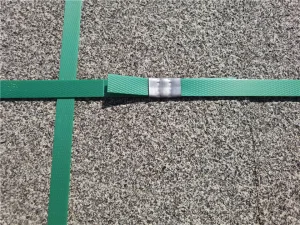
Every export crate is custom-engineered using certified fumigated hardwood timbers reinforced with galvanized steel strapping, corner edge protectors, and corrugated moisture-barrier interlining to survive multi-week maritime voyages without breakage or condensation staining.
Full CE Marking & ASTM Traceability
We provide complete factory production control documentation, including Declaration of Performance (DoP) certificates under Regulation (EU) No 305/2011, EN 1341 (slabs for external paving), EN 1342 (setts), and EN 1343 (kerbs) with full batch petrographic tracking.
Dual-Port Strategic Logistics
Direct access to Rizhao Port and Qingdao Port enables container stuffing directly at our factory yard. This eliminates multiple intermodal transshipment points, reducing logistics overhead by up to 30% and avoiding mechanical edge chipping before ocean departure.
Technical & Procurement Inquiries
Detailed answers to the most stringent engineering, petrological, and logistical questions posed by international project contractors, facade consultants, and master planners.
For light vehicular access (emergency fire lanes, commercial delivery drop-offs), we recommend a minimum slab thickness of 60 mm to 80 mm over a reinforced concrete bed. For heavy commercial transport hubs or municipal bus terminals, 100 mm to 120 mm setts or kerbs are specified to resist extreme point loads and dynamic braking shear forces without sub-surface bending failure.
Bush-hammered surfaces exhibit rounded, cratered relief profiles compared to the sharp, ragged microscopic crevices typical of thermal flaming. Consequently, bush-hammered granite accumulates less airborne road grime, releases dirt more readily during routine municipal pressure washing, and does not harbor standing water in micro-pockets, mitigating organic moss and algae germination.
Yes. While the primary face receives the pneumatic lychee texture, we routinely machine calibrated 2 mm to 5 mm pencil chamfers or micro-bevels along the top perimeters to prevent edge chipping during installation. For kerbs and stair treads, sawn, flamed, or hand-chiseled margins can be combined with a central bush-hammered traction field according to architectural shop drawings.
Yes, mechanical percussion shatters the uppermost surface crystals, scattering white light and causing the stone to appear 1 to 2 shades lighter than its polished or honed equivalent. For example, dark grey G654 turns into a modern medium-slate tone, while G603 Sesame White assumes an elegant off-white chalk finish. If a deeper color saturation is desired while retaining slip resistance, an impregnating penetrating sealer can be applied post-installation.
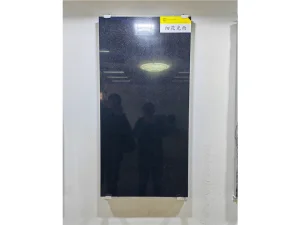
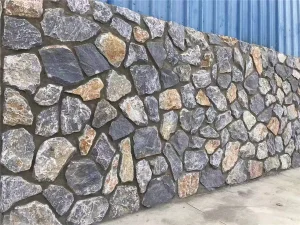
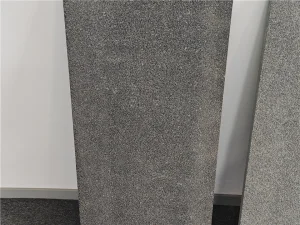
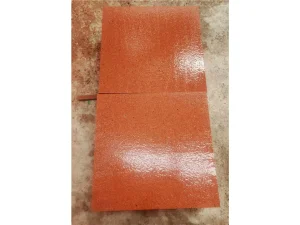
Specialized Granite Formats, Kerbs, & Architectural Elements
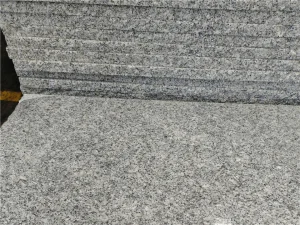
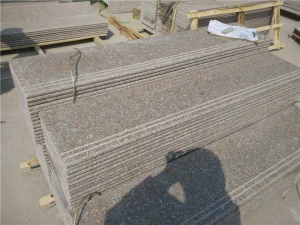
Discover additional factory-direct granite lines produced at our Rizhao workshop, configured for high-specification landscaping, monumental facades, and custom infrastructure packages.
Initiate an Engineering Review & Architectural RFQ
Submit CAD drawings, bill of quantities (BOQ), and slip coefficient criteria directly to our engineering department in Rizhao, Shandong. Receive full material scheduling and mock-up samples within 7 business days.
Factory & Quarry Audits
We welcome third-party inspectors (SGS, TÜV, Bureau Veritas) and project architects for block selection audits and production line verification at our Rizhao Stone Industrial Park facility.
Pre-Shipment Dry-Lay
For large civic paving projects, we perform complete dry-lay mockups across 200 m² to 500 m² factory bays to verify grain continuity, joint alignment, and color harmony prior to container loading.
Comprehensive Export Packages
Benefit from integrated single-source container consolidation: stone paving, granite kerbs, steel framing systems, and architectural glass hardware directly handled by our dedicated international trade team.