Precision Structural & Architectural Veneer Ensembles
Engineered for high-traffic civic hubs, facade envelopes, and tactile design applications, these selections represent factory-tested architectural standards calibrated for international container freight.
Engineering Principles of Shattered Laminated Glass in Modern Architecture
Deciphering the mechanical load dissipation, internal stress fracturing, and optical multi-refraction behavior of tri-layer ice-cracked composite safety glass assemblies.
Controlled Internal Fracturing
Shattered laminated glass (also commercially termed ice-cracked, cracked, or fractured laminated safety glass) relies on an engineered three-layer sandwich: Outer Float/Annealed or Tempered Lite + Structural Interlayer (PVB/EVA/SGP) + Center Fully Tempered Lite + Structural Interlayer + Outer Lite. Once autoclaved, a localized mechanical or thermal impulse fractures the middle core, permanently locking thousands of crystalline facets between elastic polymeric membranes.
Structural Integrity Retention
Unlike monolithic annealed glass that shatters into lethal daggers, the shattered laminated assembly maintains complete planar equilibrium. The outer virgin plies bear surface wind shear, live loads, and human contact, while the multi-ply resin layers absorb tensile and flexural stresses. Even in complete middle-layer rupture, the residual strength complies with Class 1 human impact specifications under EN 12600 and ANSI Z97.1.
Prismatic Light Refraction
The randomized micro-fissures in the shattered core layer function as internal prisms, dispersing ambient light across dynamic spectral angles. This makes the material deeply valued by luxury interior specifiers, lighting designers, and landscape architects seeking organic visual depth without sacrificing physical safety, sound transmission control, or hermetic thermal insulation.
Real-World Commercial and Architectural Deployment Scenarios
Across North America, Europe, the Middle East, and Asia-Pacific, shattered laminated glass delivers both aesthetic prominence and rigorous structural reliability in diverse localized environments.
Pedestrian Glass Bridges & Treads
Installed as heavy-load floor panels and cantilevered staircase steps. Fabricated using high-yield SentryGlas (ionoplast) or high-density PVB interlayers, these assemblies undergo 4-point bending tests to sustain concentrated human crowds while providing a visually dramatic suspension sensation.
Hospitality & Casino Feature Walls
Widely specified in luxury hotel lobbies, casino VIP salons, and flagship retail showrooms. Edge-lit by programmable RGBW LED tracks, the internal crackle network channels light laterally, casting diamond-like refraction without glare or visible hotspots.
Acoustic Privacy Office Partitions
Modern corporate headquarters require visual privacy combined with open optical transmittance. Shattered laminated assemblies diffuse silhouette outlines while dampening open-office chatter via their multi-viscoelastic damping interlayers, yielding acoustic separation up to 42 dB.
Waterfront Balustrades & Windbreaks
Engineered for high wind-pressure coastal boardwalks and luxury cruise vessel decks. Sealed with hydrophobic silicone perimeter barriers, the laminated core resists saline fog ingress, high humidity delamination, and temperature-driven thermal expansion shocks.
Technical Roadmap: Next-Generation Composite Glass Engineering
Our research and fabrication facilities push beyond conventional clear PVB assemblies, integrating dynamic polymer chemistry, nanotechnology, and solar thermal control.
Ionoplast (SGP) High-Modulus Integration
Transitioning from standard PVB to structural Ionoplast interlayers increases shear stiffness by 100x and tear strength by 5x. In shattered laminated formats, SGP prevents creeping, sagging, or edge delamination under sustained thermal loads exceeding 50°C, opening up frameless bolt-fixed point-supported facades.
Smart Switchable (PDLC) Hybrid Composites
By sandwiching Liquid Crystal (PDLC) electrochromic films alongside the fractured middle core, our latest smart laminated glass toggles from opaque frozen glacier texture to transparent crystalline sparkle within 20 milliseconds, transforming smart facades and luxury boardroom dividers.
Low-E & Solar Heat Gain Optimization
Coupling low-iron (ultra-clear) float glass with pyrolytic or soft-coat low-emissivity layers allows shattered laminated units to achieve solar heat gain coefficients (SHGC) down to 0.32 and U-values under 1.6 W/m²K when combined into double-glazed Insulated Glass Units (IGU).
Chinese Factory Supply Chain Resilience & Precision Scale
Harnessing raw material upstream integration, computer-controlled mega-autoclaves, and direct multimodal port linkages to eliminate global project bottlenecks.
High-Pressure Vacuum Autoclave Infrastructure
Equipped with 3300mm x 8000mm oversized industrial autoclaves operating at 145°C and 13.5 bar pneumatic pressure. Multi-stage thermal ramp cycles ensure total bubble elimination, zero residual moisture, and absolute cross-linking density across entire production batches.
Dual-Port Maritime Hub Proximity
Strategically situated in the Rizhao and Qingdao maritime logistics corridor. Direct road haulage access from production workshops to deep-water container berths reduces domestic inland freight costs by up to 30% and compresses vessel transit dispatch times down to 48 hours from crate sealing.
End-to-End Vertical Quality Control
From initial raw float annealing inspection using polarimetric laser stress scanners to 5-axis CNC diamond waterjet edge grinding, every panel undergoes optical clarity verification, dimension gauging, and dry-lay matching under calibrated 6500K daylight simulation before crating.
Engineering Specifications & Compliance Standards
Comprehensive baseline data sheet for architectural specifiers, structural facade engineers, and procurement directors.
| Parameter / Metric | Standard Specification | Heavy Architectural Grade | Applicable Test Standard |
|---|---|---|---|
| Typical Ply Configurations | 4mm Outer + 4mm Fractured + 4mm Outer | 8mm Outer + 10mm Fractured + 8mm Outer | ISO 12543-2 / ASTM C1172 |
| Interlayer Types Available | PVB (0.76mm / 1.52mm), EVA Film | SentryGlas (SGP 0.89mm / 1.52mm / 2.28mm) | ASTM D882 / EN ISO 527 |
| Maximum Panel Dimension | 2440 mm × 3660 mm | 3000 mm × 6000 mm (Bespoke Autoclave) | EN 14449 Factory Capability |
| Visible Light Transmittance (VLT) | 84% – 88% (Ultra-Clear Low Iron) | 76% – 82% (Standard Clear Glass) | ASTM E903 / NFRC 200 |
| Acoustic Performance (STC) | 36 dB (12mm Composite) | 42 dB (26mm Structural SGP Composite) | ASTM E413 / ISO 717-1 |
| Impact Resistance Class | Class 2 (B) 2 Standard Safety | Class 1 (B) 1 High Energy Impact | EN 12600 / ANSI Z97.1 |
| Edge Finish Work | Flat polished with arris | Mitred, CNC beveled, radius corners, waterjet cutouts | DIN 1249-11 Standards |
Localized Engineering Submittals & Maritime Crating Protection
Delivering guaranteed zero-delamination export crates through rigorous moisture barrier wrapping, fumigated solid wood cradles, and full structural submittal packages.
Full Engineering Submittal Dossiers
We supply complete architectural submittal binders for municipal permits and client approval, including finite element analysis (FEA) deflection calculations, thermal stress analysis, safety drop pendulum reports, and factory material traceability certificates (MTRs) before down payments.
Fumigated Plywood A-Frame Packaging
Panels are interleaved with moisture-resistant acid-free paper and high-density EVA shock pads, hermetically encased in vacuum plastic film with silica gel desiccants. Packed in ISPM-15 certified heat-treated solid timber end-cap crates or steel-reinforced A-frames designed for crane unloading.
Global DDP / CIF Freight Management
Our multilingual logistics desk handles complete export customs clearance, maritime bill of lading issuance, inland chassis drayage, and job-site staging coordination across North America (Los Angeles, Houston, New York), Europe (Rotterdam, Hamburg, Felixstowe), and the Middle East (Jebel Ali, Dammam).
Frequently Asked Questions: Sourcing & Structural Performance
Direct technical answers addressing structural integrity, manufacturing lead times, crack stabilization, and installation methodologies.
The fractured center lite does not compromise the overall panel envelope because it is permanently bonded between two elastic polymer interlayers (PVB or Ionoplast SGP) and two intact outer glass lites. Under positive or negative wind pressure, tension and compression forces are carried primarily by the continuous outer lites, while the resin interlayer transfers shear stresses across the shattered core, retaining full structural stability without dislodging a single glass shard.
No. All cutting, edge profiling, hole drilling, hinge cutouts, and corner radius processing must be completely completed on CNC machinery prior to tempering, laminating, and internal fracturing. Attempting to cut or notch an autoclaved shattered glass panel on-site will cause irreversible interlayer separation and total delamination.
Our standard production lead time is 18 to 25 business days from final shop drawing sign-off and deposit receipt. For custom architectural projects, our factory supports flexible trial sample runs (down to 10 square meters), while standard wholesale full container load (FCL) sea freight orders offer optimal pricing economics and minimum risk of handling damage.
Installers must utilize neutral-cure structural silicone sealants (such as Dow Corning 995 or equivalent) to prevent chemical plasticizer migration that could attack PVB or SGP interlayers. Acid-curing silicones must be strictly avoided. For mechanical clamping, stainless steel (AISI 316) architectural glass clamps with resilient EPDM gaskets should always isolate metal contact from the glass edges.
By strictly procuring raw glass float stock from Tier-1 continuous float tanks and maintaining precision-calibrated thermal tempering furnaces, we ensure uniform internal mechanical stress (surface compression between 90 MPa and 110 MPa). This standardized stress profile guarantees uniform crackle density and diamond facet spread across thousands of square meters without patchy clustering.
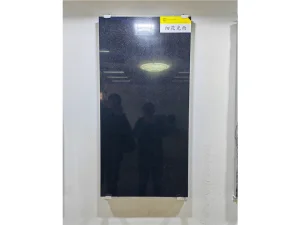
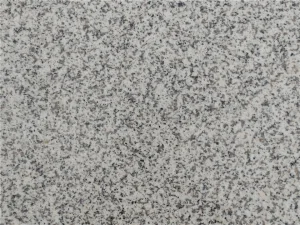
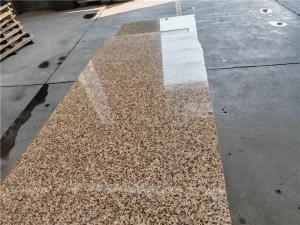
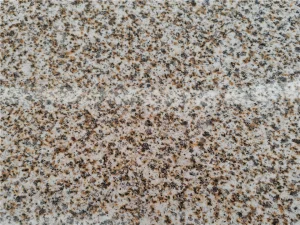
Heavy-Duty Civil, Streetscape & Architectural Sub-Systems
Complementary building envelopes, paving, cladding, and precision stone elements manufactured for turnkey project deliveries.
Initiate Your Custom Shattered Laminated Glass Order
Connect directly with our engineering department in Rizhao, Shandong. Forward your CAD blueprints, bill of quantities (BOQ), and interlayer specifications for precision engineering quotations, static load estimations, and fast-track physical range sample dispatch.